By Lydia Browne
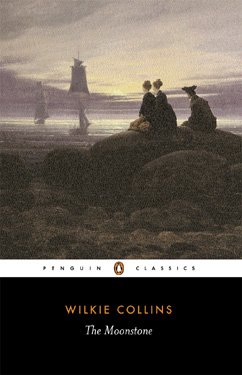
Before this past summer, I had never heard of “The Moonstone.” Nor had I heard of its author, Wilkie Collins. Wilkie Collins was far from unknown in his day.
He was close friends with Charles Dickens, and was best known for his book, “The Woman in White,” which was written in 1859. Nine years after the release of that majorly successful novel, “The Moonstone” was written.
This story, like “The Woman in White,” was a mystery novel. It centers around the large and awe-inspiring yellow gem–named The Moonstone after the way in which it glowed with more or less intensity in accordance with the waxing and waning of the moon–which is stolen from a palace in India by an English soldier at the end of the 18th century. This action seems to doom the man for the rest of his life, as the gem was believed to be under the influence of a Hindu deity. He spends the rest of his life in loneliness and suspicion that the Moonstone will be stolen back from him and he will be killed. Shortly before the end of his life, he writes in his will that the gem is to be given to his niece, Rachel Verinder. This is where the story begins.
On the occasion of Rachel’s 18th birthday, Mr. Franklin Blake–through an agreement between his father and the man who stole the diamond–is required to deliver the gem to her as her birthday present. Upon receiving the gift, Rachel is well pleased. All goes well until the night of her birthday, when the Moonstone goes missing. What follows is the complex unfolding of the mystery of the Moonstone, as told through multiple accounts and perspectives.
It was my mother who recommended that I read this book. I was hesitant at first, as it was a much older book, and looked rather long. When I started reading, it at first seemed as though my fears were correct. Starting from the point of view of Mr. Betteredge–a high-ranking servant in the house of Lady Verinder–the book was full of details that I at first thought were unnecessary. In the beginning, it seemed that nothing was really happening. But as I stuck with it, I began to see that the details both soon became part of that complex tangled knot of clues towards the solution of the missing gem, and really gave life to the characters that were giving their accounts of what they had witnessed.
The changing narratives is also something that makes this book so interesting. Though we start from the point of view of Mr. Betteredge, we then shift to the perspective of Miss Clack, and then Mr. Bruff, and so on until all the pieces fit together. And, while these different narratives provide different clues and details, they also provide sources of doubt for the details that were previously revealed by other characters. Different views on characters lead to different conclusions and suspicions. After reading the account of Mr. Betteredge, the reader may start to suspect a certain character. Then, after reading an account of another character which contradicts statements previously made, the reader starts to doubt whether or not previous accounts were biased and facts were presented in a true light. This constant cycle of thinking I knew what was going on and then realizing that perhaps I didn’t was what really drew me into the story.
Though I was surprised to find that “The Moonstone” was quite enjoyable and interesting, it was not without its flaws. It is indeed a 19th-century book, which is indicated through its portrayal of the lives of high-class Englishmen and Englishwomen, which includes some things that were quite normal then but seem rather strange now. The first of these is a romantic relationship between two cousins. This was acceptable and even encouraged for wealthy people at the time, but it seems quite gross and odd from a modern perspective.
However, the way Collins portrayed his Indian characters surprised me. Written in the age of colonialism, I expected the Indians to be portrayed as the villains or at the very least portrayed in a negative light. Collins does not pretend that there would be no bias against any Indian characters by the English characters at the time. Many of the English characters have moments of suspicion against certain Indian characters throughout the story. This is especially true when it comes to three Indian priests who are sent to recover the Moonstone and bring it back to India. From the perspective of the Englishmen, these three characters are viewed as “prowling around” and trying to “steal” the gem. But, in the end, the actions of these characters are celebrated instead of condemned.
Collins also writes surprisingly strong-willed female characters for the time period. Characters such as Rachel Verinder are portrayed as extremely determined and rather stubborn, while also allowing her to be a loving character who is very passionate when it comes to the people she cares about. She is as independent as an 18-year-old high-class girl could be in Victorian times. While the character of Rachel is criticized for her strong-mindedness–it is described as her “one defect” by Mr. Betteredge–her contributions to the plot are in the end viewed in a positive light, and her more independent traits are praised rather than looked down on.
Like me, you probably would not have picked up this book if you saw it on the shelf. But when it was recommended to me, I decided to try it. For me, “The Moonstone” became one of those books that you can’t put down. It became a story that pulled me in and kept me until its unexpected but satisfying conclusion. Despite its Victorian setting, this ahead-of-its-time-book is just as fascinating and thought-provoking as it was in 1868.
 beniciapaw.com