By Lydia Browne
Long, long ago, in the year of 2015, my family and I moved onto the Logos Hope.
My first glimpse of the large, blue and white ship was awe-inspiring, not because I had never seen anything like it before, but because I knew that this would be my home. It would only be for three months, but as an eight-year-old, three months felt like an eternity.
Melting in the horrid summer heat of Singapore, we lugged our suitcases up the gangway and then up multiple flights of stairs to our cabin on Deck 8. Deck 8 was the family deck, where most of the families with kids stayed. The lower decks were filled with young adult volunteers who seemed like giants to me at the time.
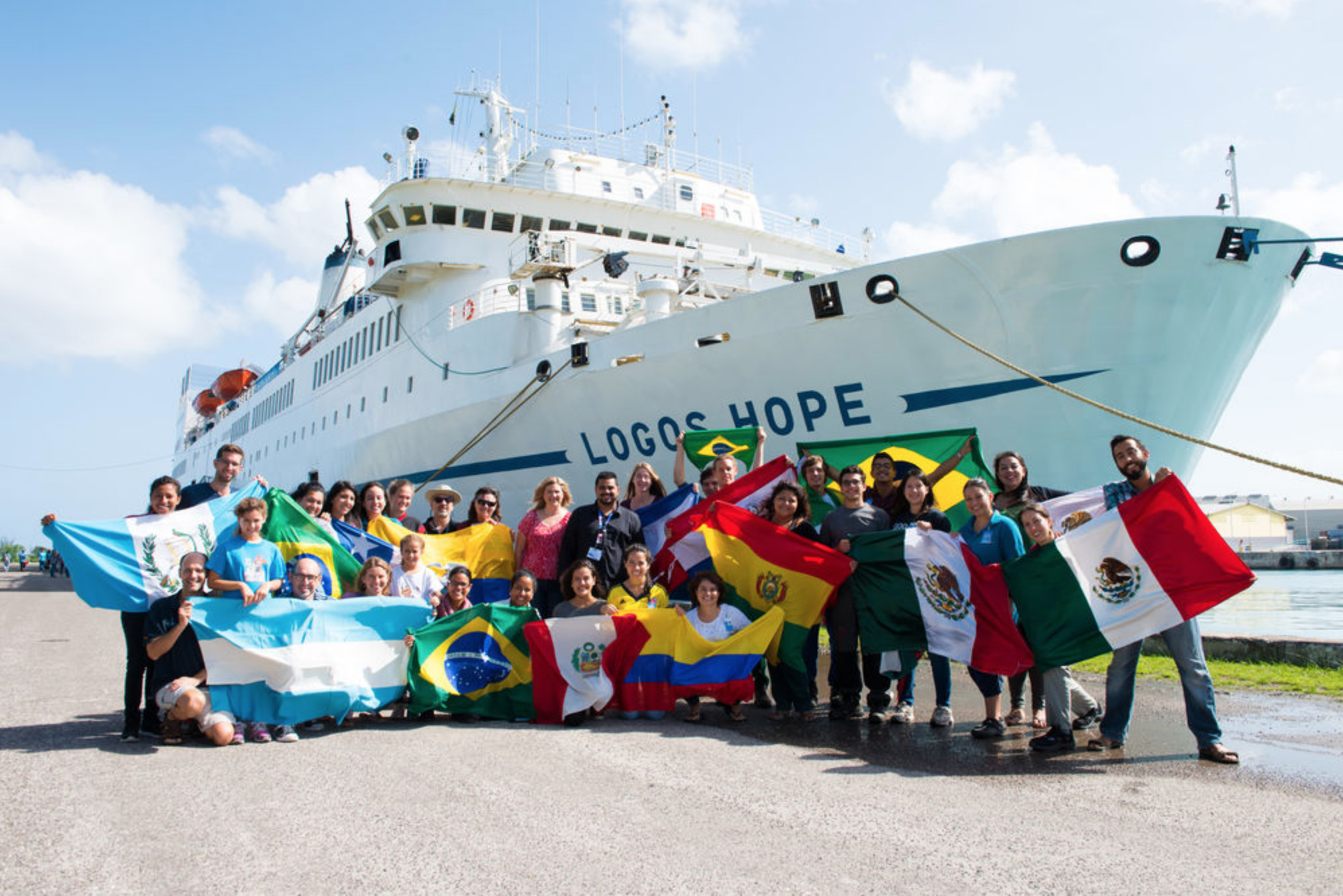
We had come to the ship around the time that a large group of those volunteers went home, after having spent two years on the ship. After we had gotten settled in our cabin, we walked to the deck outside to watch the port as the new wave of volunteers arrived. In a moment that I would remember vividly for years to come, the crew of the ship stood facing each other in two parallel lines. Each of them held their country’s flag with the person across from them, lifting it up high above their heads and allowing it to catch the gentle breeze and billow calmly up and down. They soon formed a colorful tunnel that stretched from the bottom of the gangway to the parking lot where the new volunteers of the ship stood. When given the signal, they ducked down and ran through the tunnel two at a time, all smiling and cheering. As they hurried up the gangway on the other side, we cheered and waved down at them.
Even in the short week or so before we left the dock, life on the Logos Hope quickly became a routine. Every morning my dad put on his uniform and went up to the bridge. (The bridge is the room from which a ship is commanded.) Every morning I collected my books and put them in my yellow book bag, then walked to school. I felt so grown up walking to school by myself, though I only had to walk down a few levels and to the back of the ship where the children of the crew were taught. I was put in a small class with three other kids. Though I was in the second grade in the U.S., I was put into “Year Four” in accordance with the British system of education. With me in the “Year Four” class was a girl from Canada. The other two kids in our class were in “Year Three.” One was a boy from Germany and the other was a girl from Finland. Our teacher was a very nice and beautiful woman from Australia. Those three kids became my best friends for those three months. The oldest kid in the school was a boy in “Year Six.” He seemed to be quite a lot older and we all looked up to him.
When my dad was done with his work for the day we would go walk through Singapore in the evenings. I was usually allowed to borrow a scooter from a friend since I had to leave mine in California. The city was beautiful with huge skyscrapers that glimmered in the fading sunlight. It was incredibly clean, but I was always a bit nervous since my parents had told me that it was against the law to chew gum in Singapore. I didn’t have any gum, but it made me nervous nonetheless.
After a week or so, we were out to sea. It was wonderful and yet mystifying to look out a window and see nothing but blue waves stretching into a blue sky. This was always my favorite part, but unfortunately it never lasted long enough. Within a few days we docked in Kuching, Malaysia.
At every port, we were greeted enthusiastically by a crowd of people. We would lower the gangway and rows and rows of families would climb onto the ship. They were then led in large groups to the heart and center of the ship: the bookstore. On that deck were shelves and shelves of books in different languages: children’s books, textbooks and other educational books, novels, religious texts–particularly bibles–and more. People left that room with books that they could never have had access to. They were then led through a winding hallway. Panels like comic books were painted on the walls, telling the story of The Prodigal Son. It showed a son who took his inheritance from his father and left to live on his own. But when he gets in trouble and finds himself without money or belongings, he returns to his father, ashamed and expecting his father to be mad at him, only to have his father embrace him and celebrate his return. My favorite room of all was at the end of the hallway: the café. People could get coffee and tea and muffins, but I loved the soft-serve ice cream best of all.
Sometimes in the evenings we would all gather for a meeting or a sort of assembly. One of these occasions we watched groups perform dances and display traditions from their countries. One group performed a beautiful Korean Fan dance in pink and green dresses and waved large fans in mesmerizing patterns. That night, and particularly that group, was my favorite above all the others.
We went exploring in our free time, visiting local markets and landmarks, sometimes going for hikes in the rainforest. One evening we went to see a large statue with the head of a lion and a bottom half like a fish, glimmering with lights reflected in the water below it.
The next time we went to sea was much longer. In a bit longer than a week, we arrived in Cebu. This time we were greeted by a crowd even bigger than the last.
We made many new discoveries in the Philippines and halo-halo was one of them. We went to a small store where we shared what looked to me like the largest and greatest ice cream sundae ever. But it was filled with things that I had never seen before: beans, different fruits, something purple that I would later learn to be called ube, and other brightly colored ingredients.
We stayed in the Philippines for a month. The ship would stay longer, but we were going home. Though we wished we didn’t have to, my dad and my mom had to go back to work, and I had to go back to the second grade. Despite the fact that we had only known them for three months, we had made a great deal of friends. It was quite sad to say goodbye to all of them. As we carried our bags down the gangway to the car that would take us to the airport, I hoped that I would one day return to that ship.
From the Philippines we flew to Japan, where we stayed with some friends for a week. I marveled at the beautiful pink-blossomed trees and colorful temples. We went to a sushi restaurant that brought your order to you on a little black train that weaved all throughout the building.
By the end of that week, I was ready to go home. I had had a wonderful experience, across the world from where the rest of my friends and family were, and I was aware that most kids my age didn’t have that privilege. But I was ready to go back to a place that I knew, and the people who I knew and had missed for the last few months.
Now, nine years later, I feel rather far from those months on the ship, but I still have wonderful stories to tell. I’ve always thought that I would go back to the Logos Hope as a young adult.
Operation Mobilization, or OM, is the faith-based, non-profit organization that runs the Logos Hope. This year it got a second ship, christened the Doulos Hope. The Doulos Hope will mainly function in East Asia and Pacific regions.
The Logos Hope has been active since 2009, and has had over one million visitors on average for each year in service.
This week the Logos Hope is docked in Mombasa, Kenya, where it will be met with the new group of volunteers.
They are in for one of the most fulfilling and fascinating adventures of their lives.
 beniciapaw.com