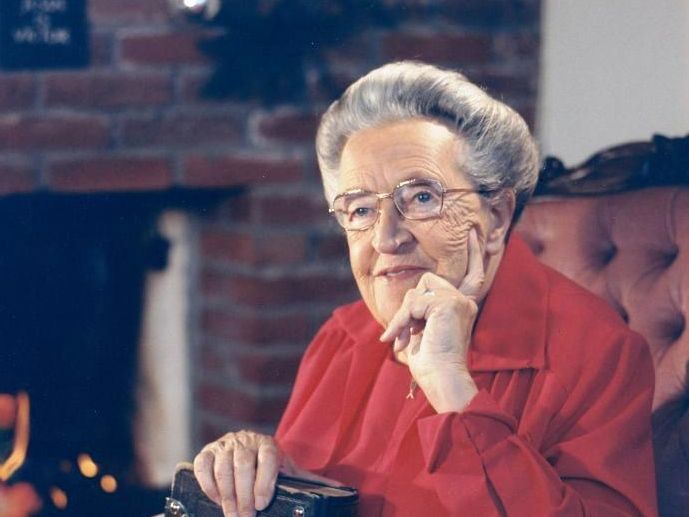
By Lydia Browne
There is no doubt that the life of Corrie Ten Boom was one of unbelievable courage. She lived for what she believed was right, and was an example of amazing strength when facing the consequences.
Born on April 15, 1892, in Haarlem, Netherlands, Corrie was the youngest of four children. Corrie’s father ran a watch shop in the family house, which her grandfather had opened in 1837. This led Corrie to become the very first female licensed watchmaker in Holland in 1922.
The Ten Boom family were committed Christians who highly valued service to both their religious community and local society. The family would often foster the children of missionaries, but their values would soon lead them to something much more dangerous.
In May of 1940, The Netherlands was invaded by the Nazis, and the occupation of Holland began. The Ten Boom home and watch shop had always been an open sanctuary for those who needed it, and despite the immense danger of doing so, the family was determined that their self-made sanctuary would stay open.
The first of many risks was to provide protection for their neighbors, the Wells family, who would hide in their house until they could escape Holland. After this, many more families and individuals would find refuge in the house, which would soon become known by those hunted by the Nazis as the “Beje House”. This title was an abbreviation of the name of the street where the watch shop was: Barteljorisstraat.
A false wall was built into Corrie’s bedroom to conceal a hidden room that was no bigger than a small wardrobe. Between 1943 and 1944, there were usually 5-6 people hiding in the Ten Boom house. When a security sweep came to the street, an alarm would warn the refugees to hurry to the secret room, giving them just over a minute before someone arrived. Corrie would become the leader of the “Beje” movement or group, which is estimated to have saved 800 Jews and refugees.
However, on February 28, 1944, it all came to an end. A Dutch informant informed the Nazi Gestapo about the activities within the Ten Boom house, and they raided the watch shop and arrested Corrie, her sister Betsie, her father, her brother Willem, sister Nollie, and nephew Peter. However, they did not find the six people hiding in the secret room. Those people stayed in the room for three days before being rescued by the Dutch underground.
Corrie’s father, who was 84, died in the Scheveningen prison in the Netherlands ten days after his arrest. After spending a while in prison, Corrie and her sister Betsie were sent to the Ravensbruck concentration camp outside of Berlin in Germany.
Even in such a horrible place, the sisters were determined to hold on to their beliefs and continue to be of service to those around them. They held secret worship services in the barracks of the women’s labor camp after their days of work, reading a Dutch Bible that they had smuggled in and whispering hymns and prayers.
Betsie’s health slowly deteriorated over the following months. Then, on December 16, 1944, she passed away in the Ravensbruck hospital at the age of 59. Just twelve days later, Corrie was unexpectedly released. She was 53 years old.
Corrie returned to her home and watch shop in Haarlem. She learned that all but one of the Jews who she had helped were safe, and that the Beje group was still in operation, though the members were in hiding.
At the end of the war, Corrie built a rehabilitation center for the survivors of concentration camps. In 1946, she started a non-profit organization and traveled to over 60 countries over the course of more than 30 years to speak about her experiences.
Corrie revisited Ravensbruck in 1959 to honor her sister Betsie and the ninety-six thousand women who also died there. While she was there, she discovered that her release from the camp all those years ago was due to a clerical error. She also discovered that just a week after her release, all the women her age at the camp were executed in the gas chambers.
Corrie wrote multiple books about her story throughout her lifetime, including The Hiding Place which was published in 1971. In 1975, a movie was made based on the book.
Corrie Ten Boom was named Righteous Among the Nations by the State of Israel. She was knighted by the Queen of The Netherlands and was invited to plant a tree in the Avenue of the Righteous Gentiles, where Oskar Schindler, another humanitarian of WWII, is honored as well. Her home, watch shop, and the secret room in her bedroom have been preserved as a part of the Corrie Ten Boom House Museum, which one can visit in The Netherlands.
Corrie’s final years were spent in a house in Orange County, California. While she was there, a series of strokes stripped her of her ability to move, write, and speak. Nevertheless, those who visited Corrie during the end of her life stated that they were amazed and encouraged by her hope and cheerful attitude. On April 15, 1983, her 91st birthday, Corrie Ten Boom passed away.
Corrie Ten Boom lived a life full of undying love, wisdom, and determination. Her years of public speaking and writing after her release have given us many timeless words, such as this:
“Worry does not empty tomorrow of its sorrow. It empties today of its strength.”
 beniciapaw.com