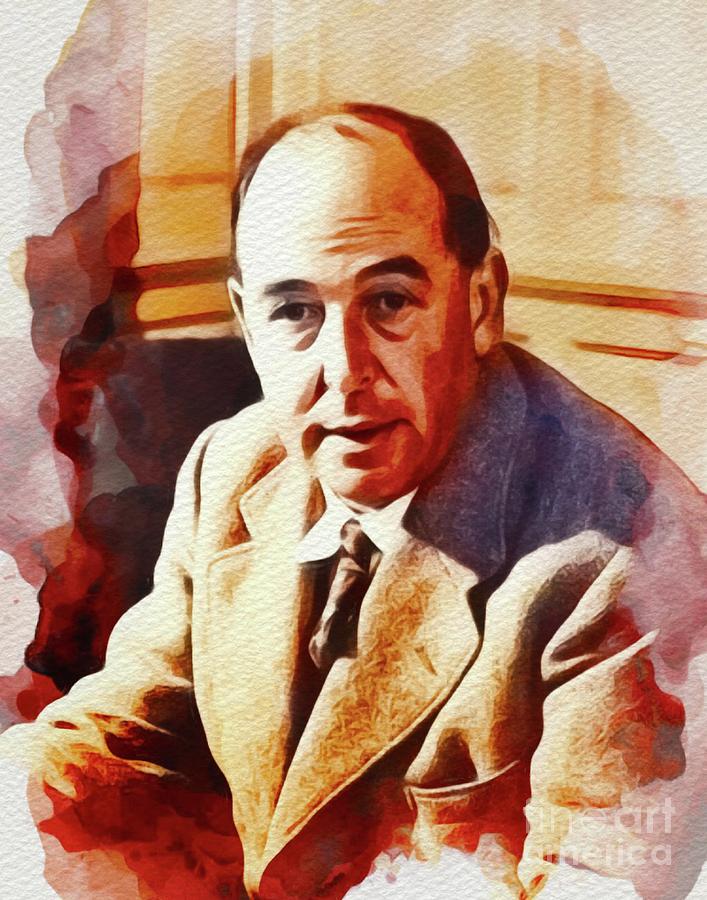
By Lydia Browne
“Failures, repeated failures, are finger posts on the road to achievement. One fails forward toward success.”
This quote by well-known author C.S. Lewis perfectly reflects his life, with the ups and downs through which he wrote his way to success.
C.S. Lewis—or Clive Staples Lewis in full—was born in Belfast, Ireland on November 29, 1898. From a young age he was called “Jack” by his family and friends. Education was held in very high esteem in his family. His father, Albert Lewis, was a solicitor, while his mother, Florence Hamilton Lewis, had graduated from the Royal University of Ireland—now known as Queen’s University Belfast—at a time in which not many women earned degrees. Because of this, both Lewis and his brother Warren loved reading. Together, the brothers created an imaginary land that they called Boxen. Lewis would write stories about this fantasy land as a child, some of which were put together in Boxen: The Imaginary World of the Young C.S. Lewis, published in 1985.
When Lewis was 10, his mother died. This meant that he and his brother went from being educated at home to attending English boarding schools. Lewis started at Wynyard School in Watford, where he encountered a rather cruel headmaster. He had much better experiences with marvelous teachers at Campbell College in Belfast, Cherbourg House in Malvern, and Malvern College. Lewis soon left to be tutored by W.T. Kirkpatrick, who helped him earn a scholarship for the University of Oxford.
However, before beginning his studies there, Lewis served in the British army during World War I. During this time, he made friends with a fellow soldier named Paddy Moore. They made a promise to each other that if one was to die, the other would look after his parent. Lewis was wounded by shrapnel and sent home, but Paddy was killed in the war. This led Lewis to choose to live as a surrogate son with Paddy’s mother, Janie.
Upon his return, Lewis went back to his education. He graduated from Oxford after studying philosophy, history, and english.
After graduation, Lewis assumed a teaching position at Magdalen College in Oxford in 1925. At that time, he joined a group of writers called The Inklings, which included J.R.R. Tolkein, the author of The Hobbit and The Lord of the Rings. Later, in 1954, he became professor of Medieval and Renaissance English at the University of Cambridge.
During this time, Lewis wrote many of the books for which he is best known. He wrote a large amount of religious literature, as he became a Christian in 1931. Books such as Mere Christianity (1952) and The Screwtape Letters (1942) were reflections on his faith. Lewis also wrote multiple series of fiction. In 1938 he published Out of the Silent Planet, the first of a science fiction trilogy. Most popular of all his writings is The Chronicles of Narnia book series. These fantasy books, starting with The Lion, the Witch and the Wardrobe (1950), have been children’s classics for decades. The last of Lewis’ novels was Till We Have Faces (1956). In what many call his most “mature and masterful work of fiction,” Lewis retold the Roman myth of Cupid and Psyche.
Later in life, Lewis got married to Joy Gresham—an American English teacher—in 1956. Sadly, she passed away from cancer in 1960.
C.S. Lewis passed away 60 years ago this month, on November 22, 1963, in Headington, Oxford.
Looking back, we remember C.S. Lewis as the skilled writer that he was. As he said, “We meet no ordinary people in our lives.” Lewis himself was certainly one of those not-so-ordinary—in fact, extraordinary—people.
 beniciapaw.com