By Ella Stone
The oldest solar eclipse ever recorded was recorded on a clay tablet. It was found in modern Syria with two possible dates, May 3, 1375 BC or March 5, 1233 BC. Only 68 total solar eclipses have been recorded since.
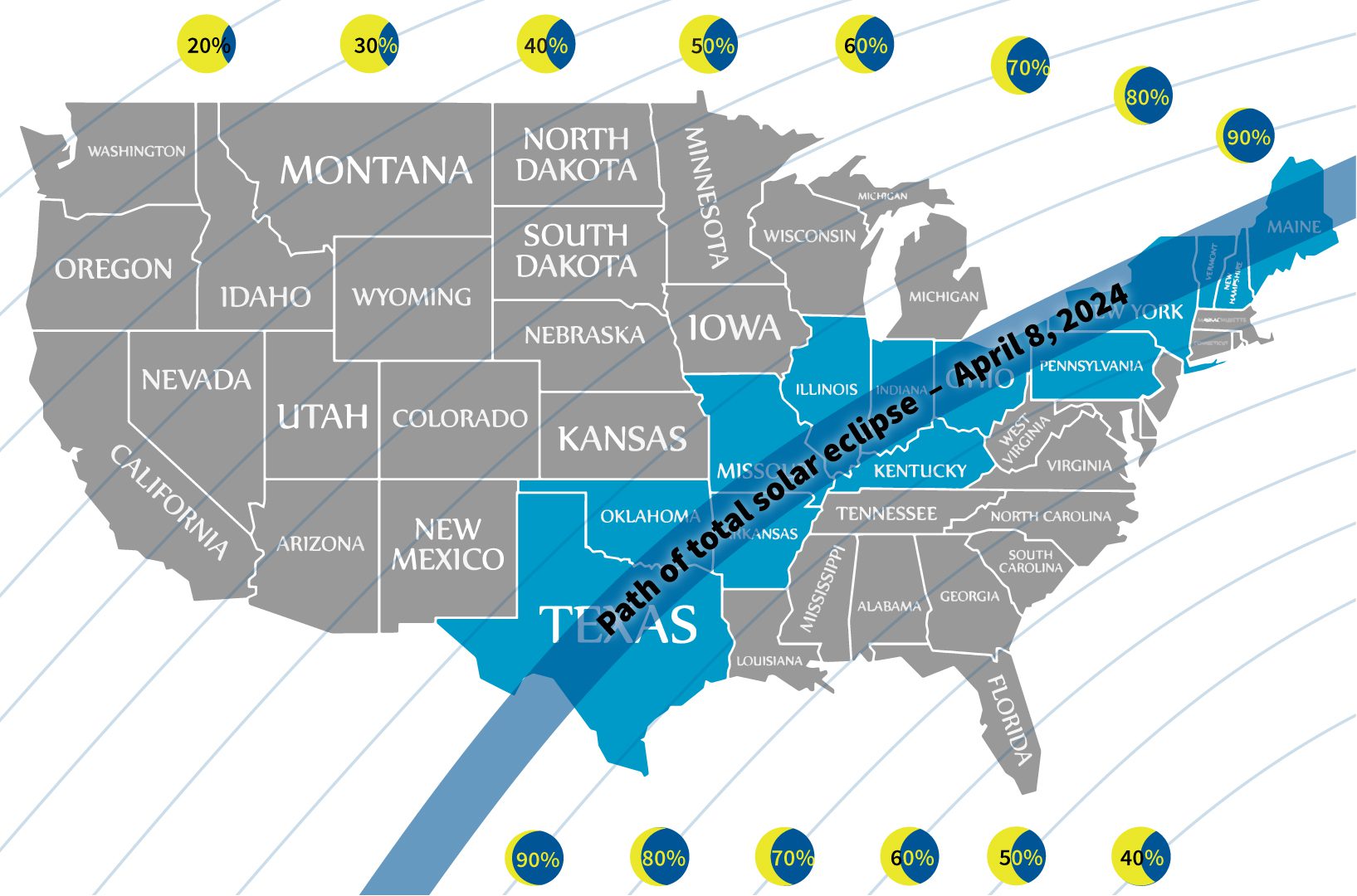
A total solar eclipse will cross North America on April 8, 2024. Solar eclipses occur when the moon, the sun, and the earth align. The moon temporarily passes in front of the sun, blocking the light. NASA is estimating that it will cross the path of roughly 31.6 million people in a 100 mile path.
The path is said to cross parts of Mexico, the U.S., and a small part of eastern Canada. If weather permits, 15 states in the US should be able to watch the moon fully cover the sun. The path will travel through Texas, Oklahoma, Arkansas, Missouri, Illinois, Kentucky, Indiana, Ohio, Pennsylvania, New York, Vermont, New Hampshire and Maine. Tiny parts of Michigan and Tennessee will also be able to witness totality if conditions are clear. The eclipse is said to begin at approximately 1:52 pm when the moon begins to block out the sun. If not, viewers in these states will see a partial eclipse, where the moon appears to take a bite out of the sun.
If you are going to view the eclipse, make sure to avoid looking at it with bare eyes. Even when the sun is partly or mostly covered, it can still be damaging. Nasa says not to watch through binoculars or cameras without the proper solar filters to avoid eye injury. Special eclipse glasses or pinhole projectors are really the only way to guarantee protection. The only time that it is safe to look at the sun with the naked eye is during the few minutes of totality, when the sun is fully covered, it is anticipated to last 4 minutes and 28 seconds. The longest totality is 7 minutes and 29 seconds, which is expected to happen July 16, 2186, but it can be as short as 10 seconds. The duration of the eclipse is and all the partial phases will last about an hour and 20 minutes.
Eclipse glasses are not like your typical Ray Bans or Oakley sunglasses. They are 100,000 times darker, blocking out nearly all visible, infrared, and ultraviolet light. As the eclipse gets closer, glasses may be available for free at schools, libraries, or astronomical observatories, as well as Amazon. You can also make your own projector by punching a hole in an index card, making it safe to look through.
Nasa is planning to stream views of the eclipse live online if you are unable to see a total eclipse. The last total solar eclipse happened in August 2017, and it was the first total eclipse to pass over the entire continent in nearly 100 years. Almost identical solar eclipses happen every 18 years and 11 months. The next total solar eclipse isn’t expected to happen until August 23, 2044 so make sure you look out for the upcoming eclipse.
 beniciapaw.com