By Lydia Browne
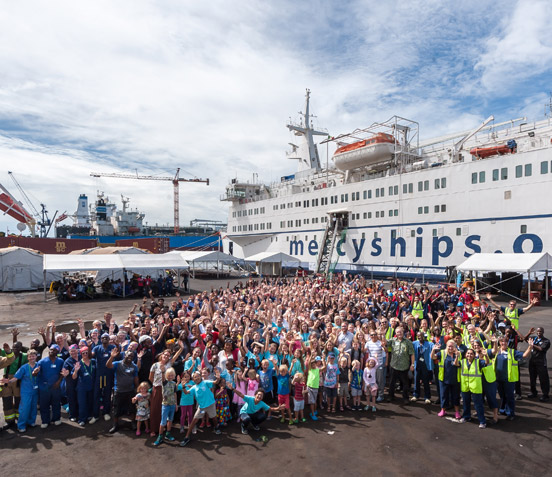
The word “Mercy” painted on the side of a ship as it pulls into port is a telltale sign for many around the world that help and hope has come to their community.
Mercy Ships is an international charity organization that sends hospital ships globally to provide medical care to communities that lack access to vital procedures, particularly surgical procedures. Each ship is crewed by volunteers experienced in various medical professions, maritime careers, and a variety of other work. Per the organization’s website, Mercy Ships is “transcending borders” and “changing lives.” Since the beginning of the organization in 1978, Mercy Ships has impacted more than two million people. Mercy Ships’ volunteers have performed over a hundred and ten thousand surgical procedures and have trained over fifty-two thousand professionals. Mercy Ships continues to receive help from over one and a half thousand volunteers per year. The organization’s use of ships as their means of reaching in-need communities continues to prove wonderfully successful because over half of the world’s population lives near a coast.
Mr. and Mrs. Lewis, a local couple who met during their years of volunteering on the Caribbean Mercy, experienced the impact that the organization has on the communities that it visits. Mrs. Lewis, who worked as the dining room manager on the ship, decided to volunteer because of her desire to do something different and impactful in the world. As for Mr. Lewis, who was an officer on the ship, his desire to volunteer was inspired by tragedy. “The genocide in Rwanda got me started,” he said. “[When] I learned about what had happened, it made me want to do something good in this world.”
Both went on to describe the highs and lows of their experiences. “I loved working with the crew,” Mrs. Lewis recalled. “We all had the same vision and goal of helping people. I got to meet people from all over the world. Many were so friendly and thankful, and it was wonderful to know that you were making a difference in their lives. I remember several stories of people whose lives were impacted. There was one mother who walked for two days to the ship so that we could help her child who had fallen and injured his eyes. In one country, we took a taxi, and the driver of the taxi thanked us profusely for the medical care that we had given to his mother. The hard parts were missing my family, and the instances when we realized that we couldn’t do anything to help someone.” For Mr. Lewis, the best part was, of course, meeting his future wife. Apart from that “there were a lot of good experiences.” Lewis continued, saying “I’ve always loved the starry nights at sea. More importantly, it was my first time around an international community. Volunteers come from all over the world, and [each one of them] had a big effect on me. Many of them are still working with Mercy Ships today. I cherished the opportunity to bring hope to the poor and the needy in different communities. We met some beautiful people, and saw some of the difficult challenges that people face around the world. The hardest part for me was when it was time for me to leave the ship.”
Now, the couple reflects on what they gained from Mercy Ships. “I gained worldwide friends and a knowledge of how life works in third world countries,” Mrs. Lewis said. “I was able to see so many parts of the world, and I’m satisfied to know that I’ve been able to help people. I’m left with a lot of memories of really cool experiences.” Mr. Lewis credits his experience with helping him develop a greater compassion for the poor.
However, since the Lewis’ contribution to Mercy Ships, the organization has experienced many changes. “Our ship—the Caribbean Mercy—is no longer in use,” Mrs. Lewis explained. “They have a new ship—the Global Mercy—which was the first purpose-built hospital ship. The ships even have a Starbucks onboard.” Mr. Lewis mentioned that Mercy Ships has “been able to partner very well with governments and communities throughout Africa so that they can train medical staff there. This will mean that instead of relying on doctors to come to them, they will be able to help their own people.”
Both Mr. and Mrs. Lewis were enthusiastic in encouraging others to participate in the organization, saying, “It’s a great opportunity for young people to try out different jobs, grow, meet different people, and explore the world. You don’t have to be a mariner or a doctor, there are lots of different jobs to do on the ship. You don’t even have to be young. At any stage of life, there’s a need for you onboard. Mercy Ships has a proven ability to partner with communities and bring aid to the poor and needy. If you have the opportunity, go for it. It’s life enriching, eye opening, and you’ll never be the same.”
 beniciapaw.com