By Parker Soughers
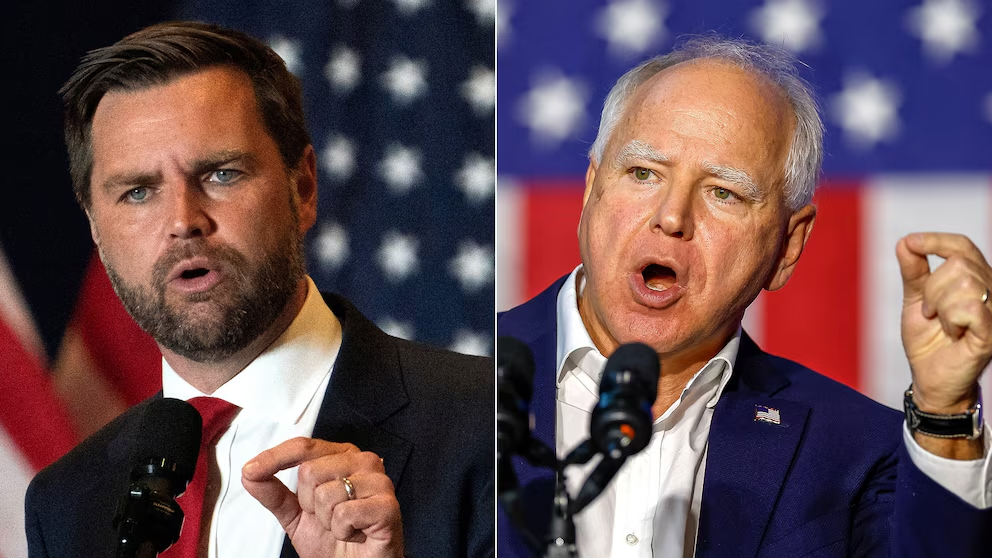
Tuesday, October 1st, Vice President nominees Governor Tim Walz and Senator J.D. Vance went head to head in what would be the first and only Vice President debate. This debate in particular served as each party’s last shot to fully advertise exactly what each administration supports, clarify policies, and to gear attacks against their opponents. The topics ranged from abortion rights, Hurricane Helene, climate change, and to Israel and Iran.
A key difference between the VP debate and the Presidential debate was the demeanor of the candidates. Where former President Donald Trump was rash and disrespectful to his opponent and the moderator, J.D. Vance remained respectful throughout the debate, except for a few key moments.
For Governor Tim Walz, a nervous beginning to the debate gave way to attacks on the Trump campaign on abortion rights and January 6th. However, both candidates agreed on multiple different domestic issues as crises that need addressing. Walz addressed Vances views, stating, “I agree with a lot of what Sen. Vance said about what’s happening—his running mate, though, does not, and that’s the problem.”
When turning toward the topic of immigration and the border crisis, the candidates widely differed in statements. Vance focused back on Springfield, Ohio, which is a topic that Trump had failed to constructively explain his policies on. Vance talked about illegal immigrants in Springfield, to which he was fact checked by the CBS moderators, explaining that there were over 12,000 legal immigrants that Vance was widely ignoring.
Another topic that addressed Trump’s shortcomings in the previous debate were his “concepts of a plan.” Vance refused to reveal any details about the Trump administration’s plan for health care, which left the door wide open for Governor Walz. Walz spotlighted Trump’s failure to repeal Obamacare during his presidency—a promise that Trump consistently campaigned with in 2016.
The January 6th insurrection became a key moment for Walz. Vance avoided and side-stepped questions on Trump’s support of the insurrection and refusal to acknowledge that he lost the 2020 election. This proved to be an advantage for Walz. In his response, he asked Vance if Trump lost the 2020 elections, to which Vance answered, “Tim, I’m focused on the future.” Walz retorted, “That is a damning nonanswer.”
Vance continually avoided the topic, only aiding Walz in proving his point. Walz compared moments from the last election and provided a wake up call to Americans: “Here we are four years later, in the same boat,” Walz said. “The winner needs to be the winner. This has got to stop. It’s tearing our country apart.”
One of the more powerful moments in the debate came from Walz’s approach to abortion. While he argued that abortion rights were human rights, Vance claimed that abortion rights lay in the hands of the beliefs of each state. Walz kept pushing Vance on his back foot, while Vance attempted to push anti-abortion policies. Walz finished by bringing up anecdotes of women who have died to the overturning of Roe v. Wade.
Reports from a poll CBS put out right after the debate had ended revealed interesting results. When asked who had won the debate, Vance received a barely higher percentage at 42% agreeing he won versus Walz’s 41%. However, the favorability ratings of Walz shot up after the debate by 8%. Ratings of Wal’s coverage of multiple issues and his preparedness to step in as president if needed were consistently higher than Vance’s.
Regardless of the outcomes of the debate, many have regarded it as refreshing. CNN described the debate as, “Unusually normal…the kind that hasn’t been seen over the past decade of presidential debates.” Walz and Vance shook hands following the debate—a sign of respect that differed greatly from attitudes of each other’s campaign.
 beniciapaw.com