By Sean Mueck
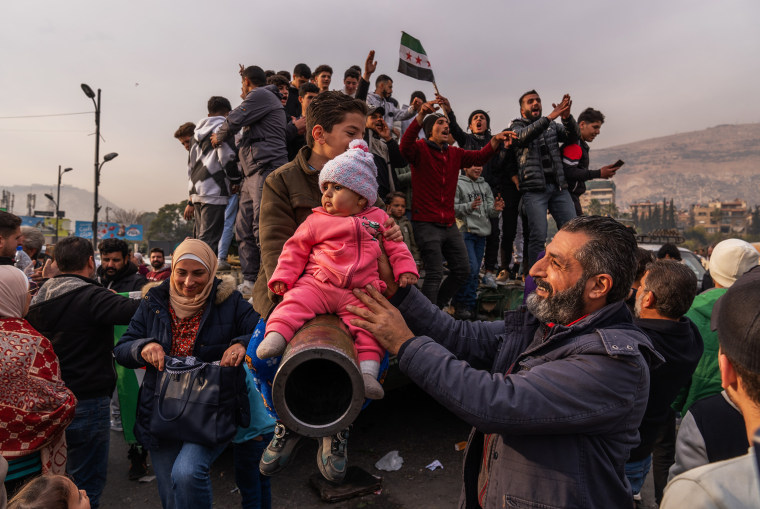
On December 8th, Syrian rebels advanced into Damascus and seized control of the capital city unopposed. This quick takeover brings an end to a stunning ten-day offensive that saw a complete, systematic collapse of President Bashar al-Assad’s military control over the country.
The offensive started on November 27th by a coalition of Syrian opposition, led by the Hay’at Tahrir al-Sham (HTS) and the Turkish-backed Syrian National Army (SNA), when they swiftly launched a surprise attack on Assad’s government forces in the cities of Aleppo, Idlib, Hama, and Homs. Pro-opposition forces successfully took over Aleppo on November 30th.
Rebel forces continued to move south until they reached the outskirts of Damascus on December 7th and officially took control a day later.
The culmination of the offensive ended a 13-year-long civil war and six decades of Bashar al-Assad’s family’s iron-fist regime, which left millions living in extreme poverty in the country and as refugees seeking safety abroad. Assad and his family fled the country and flew to Moscow, where they are receiving asylum, according to the Russian ambassador to International Organizations, Mikhail Ulyanov.
The sudden overthrow of Bashar al-Assad will have lasting effects over the entire region, as allies Russia, Iran, and Hezbollah will have to reconduct their foreign policy and influence.
Russia has already begun pulling out of the country but has stated they will still have some presence. With this, Syria’s de facto government stated that Russia should “reconsider” its troops in the country. This came as a huge blow as Syria was one of Russia’s most important allies, and they would have greater access to influence in the region. Syria is also home to Russia’s Tartus Naval Base, the country’s only base on the Mediterranean, helping spread influence over the important region. Whether Russia will hold onto the base is currently unclear.
Iran’s supreme leader went on to blame the U.S. and Israel for the fall of Assad’s regime. He went on to say on state TV that “There should be no doubt that what has happened in Syria is the result of a joint American and Zionist plan.” The fall of Assad’s Syria will pose a major issue for Iran’s control over the greater region. Syria’s fall has cut off a buffer between Israel and Iran, and it will be significantly logistically harder to supply munitions to Hezbollah.
Hezbollah will suffer a major blow as they become more isolated from their allies. Head of Hezbollah Naim Qassem stated that the group had lost its supply route through Syria.
One of the largest emerging winners from the fall of Assad’s Syria is Turkey. Turkey has long had high tension with the country, and the fall of Assad will let them spread influence over the region much easier. Turkey has historically had significant conflict with the ethnic Kurdish autonomous zone in northeastern Syria. Turkey considers the Kurdistan Worker Party (PKK) a terrorist organization, and a fallen Syria will open up potential for Turkey to grow their military presence in the region.
Over the next few months, the world will wait and watch as the balance of power shifts in the increasingly important region. Russia and Iran are losing out while Turkey and the people of Syria gain significant influence. How the global stage changes greatly relies on the future of Syria as a critical gateway to influence over the Middle East.
 beniciapaw.com