By Sean Mueck
United States public transportation has long been overshadowed by the car. Modern day car culture in the United States has shaped our country in uncountable ways. The way we work, play, and interact with our world has long been bound to the car. The car led to migration from the city to the suburb, where many Americans live today. Our environment has been shaped by the freeway, our daily commutes shaped by traffic.
The Bay Area is no stranger to this change. From Interstate 80, to the MacArthur Maze, the bottom deck of the Bay Bridge becoming car only, and the infamous Central Freeway and Embarcadero Freeway. The Bay Area was reshaped and restructured to fit the car. But despite this change, many forget the rich history of public transportation this region has had. The San Francisco Bay Area has always been home to trailblazers, from the Gold Rush of 1849, to the rise of Silicon Valley, this has always been a region of change and adaptation. But even with our rapid change, we should remember the good of the past.
The first real form of public transportation infrastructure in the Bay Area calls Benicia home. The city of 28,000 was once thought to be the next pacific metropolis, beating out the likes of San Francisco. Despite this never coming to fruition, Benicia has held many records of its own. The transcontinental railroad once ran through Benicia on its way from Sacramento to Oakland and San Francisco. The Steamboat Solano was also in Benicia. The Steamboat Solano ran between Benicia and Port Costa for 51 years, between 1879 to 1930. The Solano would carry passengers on the transcontinental railroad from Benicia across the Carquinez strait to Port Costa. The transcontinental railroad would board the Solano and then reconnect to the rest of the track once reaching Port Costa. The Steamboat Solano held the record for the largest Steamboat in the world for an incredible 35 years, until it was bested by its sister ship, the Contra Costa. This impressive feat of engineering was eventually decommissioned because of the opening of the railroad bridge which now runs in the middle of the Benicia-Martinez Bridge. Both the Solano and the Contra Costa were sold for scrap, but you still can find a section of the Solano’s A frame beached in the San Joaquin river near Antioch, serving as a breakwater.
The Steamboat Solano was one of the most important pieces of transportation infrastructure in the Bay Area, allowing passengers to eventually reach San Francisco, where they could ride on Muni.
San Francisco’s Muni or San Francisco Municipal Railway now serves as one of the most robust transit systems in the entire country. The system hosts 44 daily bus routes and 6 trolley lines, along with the cable car and the historic E Embarcadero and F Market streetcars. Despite this vast infrastructure, many forget the rich history that this system has. San Francisco’s Muni is the oldest public transportation company in the United States. Its history runs all the way back to 1902 with the United Railroads. The United Railroads was a private company that bought out over ten separate other transit companies. United Railroads mainly ran multiple Market Street trains until, eventually, in 1909, San Francisco voters approved a bond for municipally operated transit. This, in return, created the Muni we know today.
In 1912, Muni ran for the very first time. The very first lines were the A and B Geary streetcar, which both ran between downtown and 33rd avenue. 1917 saw the opening of the first line we know today. The J Church line was first unveiled in 1917, along with the very first buses in the city, which ran in Golden Gate Park. But the success of 1917 would very quickly be outshined by one of the biggest infrastructure projects in the city at the time. The twin peaks tunnel ran from Castro station under twin peaks, stopping at Forest Hill station and the now defunct Eureka Valley station before emerging at West Portal, which stood as the western terminus for the tunnel. The second and third lines we know today both ran through this tunnel. The K Ingleside first ran through the tunnel in 1918, with the L Taraval running through the tunnel the year after. West Portal stood as a testament to San Franciscans’ ability to achieve massive feats. The tunnel would successfully aid in the building of the western parts of the city, which during that time was mostly sand dunes and occasional farm land. Over time, the western part of the city started growing until it reached the point it is at today. Despite the city growing around West Portal, the feat of engineering is still a marvel today.
Post World War II saw some of the biggest changes to the Muni system. Nearly all trolley lines were scrapped for buses for easier efficiency. We then saw the rise of the trolley bus, which aided in tackling the steep streets the city is known for. Little by little the system has transformed into the service we know today. Next time you ride the N Judah, K Ingleside, M Oceanview, L Taraval, J Church, T Third, or any of the historic lines and cable cars, remember the history of these lines and how they brought a new age of public transportation to the city by the bay . The city would be vastly different without their presence.
However, even with Muni’s vast importance, it only serves San Francisco and a small portion of Daly City. The advent of the car created a migration to the suburbs. San Francisco and Oakland were losing residents while Concord and Walnut Creek were thriving. The city cores were shrinking and the suburbs were thriving. It was clear that the Bay Area needed a new transit system to serve the entire region, it needed a space age system. On September 11, 1972, Bart answered the call.
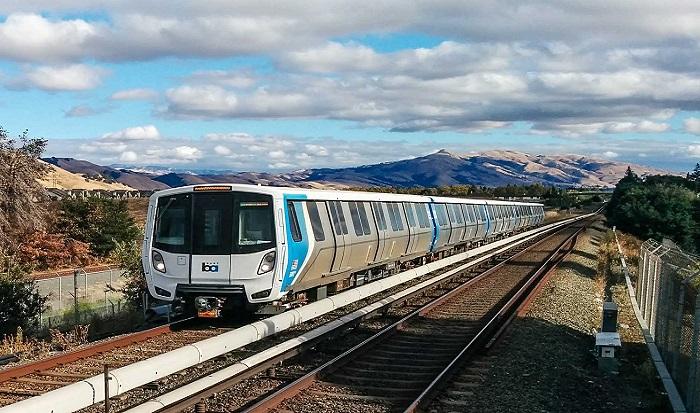
Bart, or Bay Area Rapid Transit, was more than just a system. It was an overwhelming success for community leaders. Despite first being opened in 1972, Bart has roots much further in the past. In 1946, the idea of Bart first took shape as an idea from civic leaders in multiple Bay Area communities. But their dreams would have to wait for many years. Finally in 1957, engineers began organizing plans. Later that year, the San Francisco Rapid Transit District was formed by California. The district was composed of Alameda, Contra Costa, Marin, San Francisco, and San Mateo counties. By 1961, plans were taking shape, envisioning branches of lines stretching to Concord, Richmond, Fremont, and Palo Alto. The plans also included a tunnel under Market Street, a tunnel under the bay between San Francisco and Oakland, and a tunnel under Geary Street, which would run on a lower deck on the Golden Gate Bridge.
Despite the high hopes of leaders, Bart would face its first major hurdle. On April 12, 1962, San Mateo county pulled out of Bart, which would then prompt Marin county to pull out of the Bart project as well. This blow resulted in the cancellation of the peninsula branch extending to Palo Alto and the Geary Subway which would connect Bart to Novato. Despite the challenges, Bart persevered, and would continue until ground broke in 1964.
On June 19, 1964, President Lyndon B. Johnson watched over the first segment of the test track, which ran between Concord and Walnut Creek. This was the United States’ first truly modern transit system. Construction on the system would continue until the very first public ride on September 11, 1972. Advocates and residents of the Bay Area walked into the brand new MacArthur station in Oakland, which sits in the Highway 24 median. The first train traveled about 24 miles from MacArthur to Fremont station. Later that year, President Richard Nixon rode bart and congratulated those who worked to build it for “setting an example for the Nation.”
On November 3, 1973, the Market Street subway opened and the next year on September 16, 1974, the trans bay tube opened. The service was finally completed after over 30 years of work and planning. The system was truly space age, and perhaps the best example of this was the trans bay tube. The trans bay tube is a 3.6 mile underwater bart tunnel which carries the Yellow, Blue, Green, and Red lines from West Oakland station to Embarcadero station under Market street in San Francisco. The tube was and still stands as a feat of engineering. It now serves as a staple of Bart and the entire Bay Area. Over time, the system transformed into the service it is today. Currently, Bart runs 5 lines: the Yellow line from Antioch to San Francisco International Airport, the Red line from Richmond to Millbrae, the Orange line from Richmond to Berryessa North San Jose, the Green Line from Daly City to Berryessa/North San Jose, and the Blue Line from Daly City to Dublin/Pleasanton.
Despite all the challenges leaders and activists faced while building every transit system in the Bay Area, they all persevere and overcome challenges. Transit in the Bay Area has a long and storied history to get to the point it is at today. Next time you ride a Yellow line train from North Concord/Martinez to Powell Street, or a M Ocean View trolley from Stonestown to Civic Center, or if you’re standing on the Benicia First Street pier looking out to Port Costa, remember the history. Remember the people who dreamed and worked to create these systems. Remember the activists who brought up legislation and bills. Transit is only as good as those who support it, so make sure the next generation will be able to enjoy the services which keep our region moving.

