By Daniel Malki
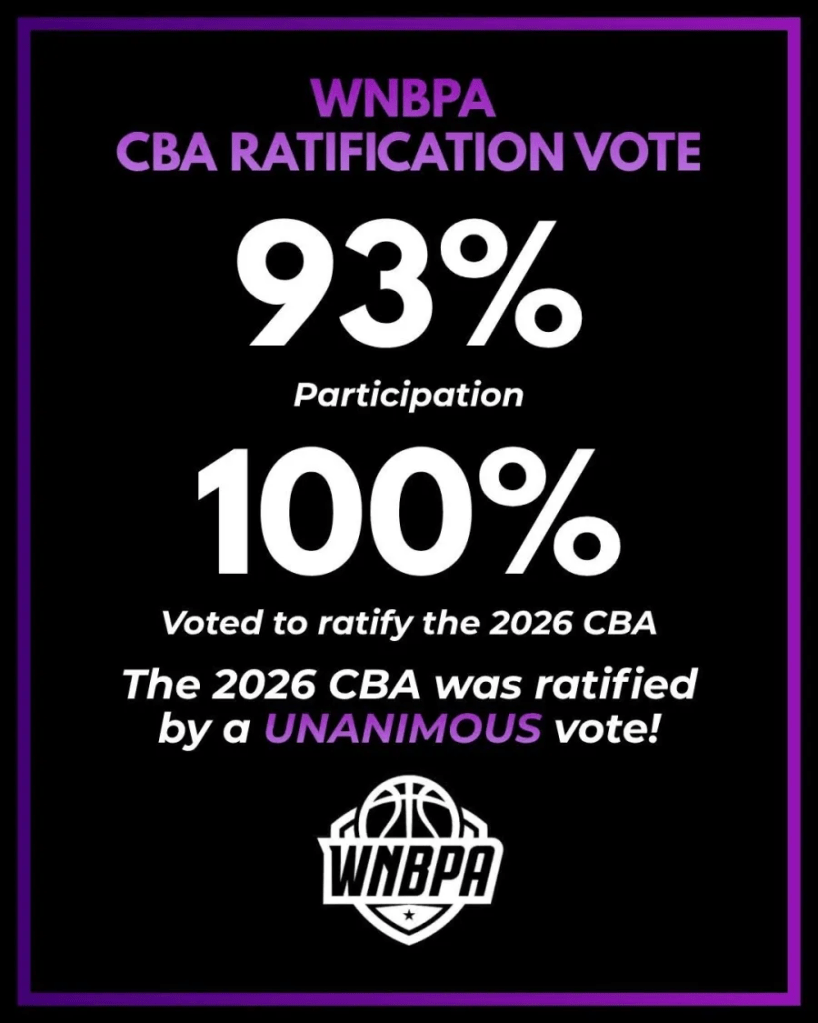
WNBA players voted unanimously to approve a new 7-year Collective Bargaining Agreement (CBA) that includes a massive salary increase and revenue sharing. This deal is a huge improvement for women’s sports, It also avoids work stoppage and creates the first million-dollar women players in league history.
The author of the article “WNBA’s Board of Governors joins players in unanimously ratifying new CBA” Sabreena Merchant focuses on the unanimous support with over 90% of the participation and the union’s focus on knowing their worth as players to support future generations. The deal is guaranteed to last from 2026 through 2032,
The most surprising part of the agreement is a five fold increase in the salary, Previously it was $1.5 million in 2025, the salary will go up to $7 million for the 2026 WNBA season. This allows growth for all contract levels, with major salaries starting at $1.4 million. The average salaries are about $600,000, and minimum salaries would be $300,000.
For the first time player pay is because of the league’s success through a 20% revenue. WNBPA President Nneka Ogwumike announced this, stating that for the first time players salaries are used in a meaningful share of the WNBA league’s profit.
WNBA Commissioner Cathy Engelbert said the ratification is the start of a bold new era which was made possible by the dedication of the entire WNBA league. The agreement also includes major improvements such as new rooms at home arenas, paid leave for non birthing parents, and private practice facilities starting in 2028.
This agreement ensures that major players and incoming rookies are valued in the business with fair pay. Bigger players like Caitlin Clark are already happy about the deal. This could serve as a model for all women’s sports because it shows that the athletes are valued.
With 10-hour bargaining sessions and late-night negotiations now in the rearview, the WNBA is at a point of stability and expansion, starting with a 44 game schedule in 2026 that is set to grow as the league reaches a new record 18 teams by 2030.

